How to Go to a Football Game in Colombia: Tickets, Seats, and What to Expect
Going to a football match is one of the best, cheapest, most genuinely local things you can do in Colombia, and most visitors never do it because they are not sure how. This is the practical how-to: buying the ticket, choosing the seat, and walking in like you have done it before.
If you do not yet know how the league works, start with our explainer on Colombian football leagues and cups. This piece assumes you just want to get into a stadium.
Buying tickets
You have three realistic ways in.
- TuBoleta. The main Colombian ticketing platform, and where most clubs sell. You can buy online with a foreign card most of the time. Expect to register an account and, increasingly, to tie the ticket to an ID.
- The club’s own website or app. Bigger clubs like Atlético Nacional, Millonarios, and América sell memberships and single tickets directly, sometimes cheaper than the resale platforms.
- The taquilla. The stadium box office. For a normal-league game that is not selling out, turning up and buying at the window is completely viable and avoids online fees. For a clásico or a playoff, do not count on it; those sell out.
One firm warning on price. If you Google a Colombian match and land on an international resale site quoting fifty or a hundred US dollars, close the tab. Those are tourist-trap markups. Real face-value tickets are cheap. For a normal league game, expect roughly COP 35,000 to 70,000 for the standing ends and the cheaper general sections, and COP 90,000 to 180,000 for a numbered seat in the covered occidental. A clásico, a playoff, or a final costs more, sometimes two or three times as much: a recent league final ran from roughly COP 110,000 in the ends to over COP 400,000 for the best occidental seats. But a quiet midweek league match can still cost you less than a nice lunch.
Bring your passport or cédula. Colombian stadiums increasingly check ID against the name on the ticket, part of the security regime around the barras.
Choosing your seat: the sections explained
Colombian stadiums almost all use the same classic four-tribune layout, splitting the crowd into four grandstands by fan culture, price, and comfort. Picking the right one is the single most important decision you will make.
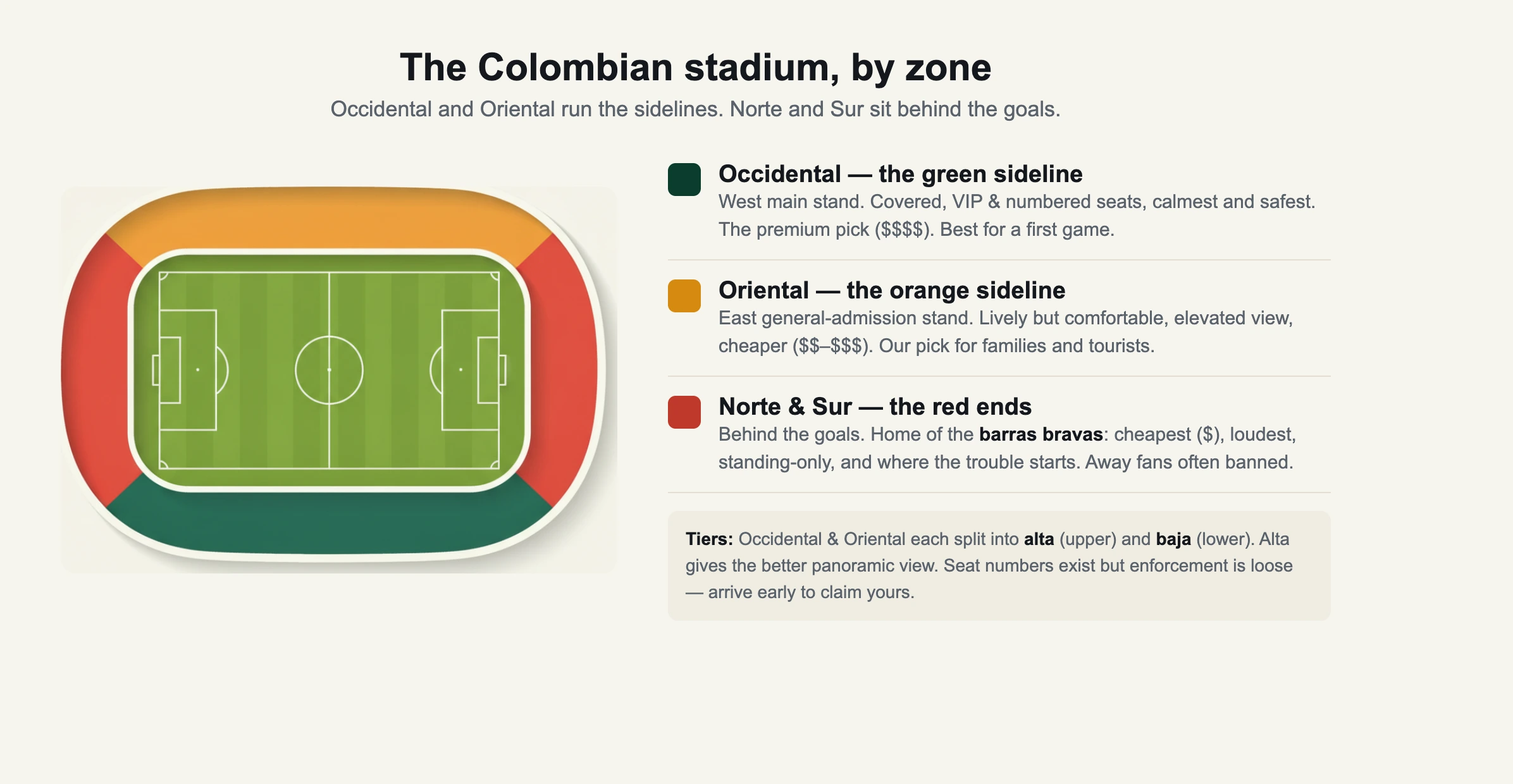
- Occidental (west). The premium stand: usually the only one with a roof, home to the VIP boxes and the numbered, seated tickets. Most expensive, best unobstructed view, calmest crowd, and the safest. If you want the easy first game, sit here.
- Oriental (east). The general-admission grandstand across the pitch. It strikes the best balance of lively atmosphere and comfort, with an elevated view, for less than the occidental. This is the one we recommend for families and tourists who want some of the noise without the standing ends.
- Norte and Sur (the ends). The goalside stands, strictly territorial, and home to the barras bravas, the organized hardcore support. Cheapest, loudest, usually standing-only, with the flags, drums, flares, and ninety minutes of nonstop song. They are also where almost all the trouble starts, and away fans are often not welcome here at all.
A couple of details that trip up foreigners. Inside the occidental and oriental, tickets split into alta (upper tier) and baja (lower tier); the alta usually gives the better panoramic, tactical view of the pitch. And while tickets carry assigned seat numbers, enforcement is loose, especially in the oriental as kickoff nears, so if you want your specific seat, arrive early and claim it.
The sur in particular is the heart of the spectacle and the heart of the risk. It is an incredible place to experience a match and a genuinely intense, physical environment: packed, drunk, and surging, where even buying a beer at halftime is a shoving match. Each side sings its own songs nonstop for the full ninety minutes, and you are expected to sing and jump along, not stand and watch. Go there once you know what you are doing, with a local, and never with kids or anything you cannot afford to lose. For your first match, watch the sur do its thing from the comfort of the occidental.
What to bring (and what to leave)
- Cash, in small bills. For food, drinks, and the taxi. Cards are not reliable inside.
- A cheap phone or none. The crush in the popular sections is prime pickpocketing territory. Your day-to-day risk at a Colombian match is theft, not the rare violence that makes the news.
- Your ID. As above.
- Neutral or correct colors. Wear the home team’s colors or nothing identifiable. Never wear one team’s shirt in a rival section or a rival city. For a derby, when in doubt, wear neither.
- Leave the jewelry, the good camera, the backpack full of stuff you would hate to lose. Security screening is strict and travels light.
Matchday, start to finish
Get to the neighborhood early. The hours before kickoff, in the bars and streets around the stadium, are half the experience. Eat before you go in; stadium food is a scrum. Find your gate, expect a thorough pat-down, and settle in.
For the big games, check two things in advance that foreigners always miss. First, whether away fans are even allowed: for high-risk clásicos, authorities sometimes ban the visiting barra entirely, or restrict the match to home support only. Second, how you are getting home: have a plan that is not “walk through the postgame crowd.” Order a car, or wait out the initial surge inside, especially after a derby.
Where to start
If you want the full-volume experience, the great derbies are the Clásico Paisa in Medellín, the Clásico Cafetero in the coffee region, and the national Superclásico between Nacional and Millonarios. But honestly, your best first game is a quiet midweek league match in whatever city you are in: cheap, easy, no drama, and a perfect introduction to why Colombians love this so much.
Sit in the occidental, buy an arepa, and watch a country’s favorite thing up close. For the wider safety picture, our is Colombia safe in 2026 guide has you covered.